Peterborough, Ontario
CENTURY 21 PROPERTY ZONE REALTY INC.
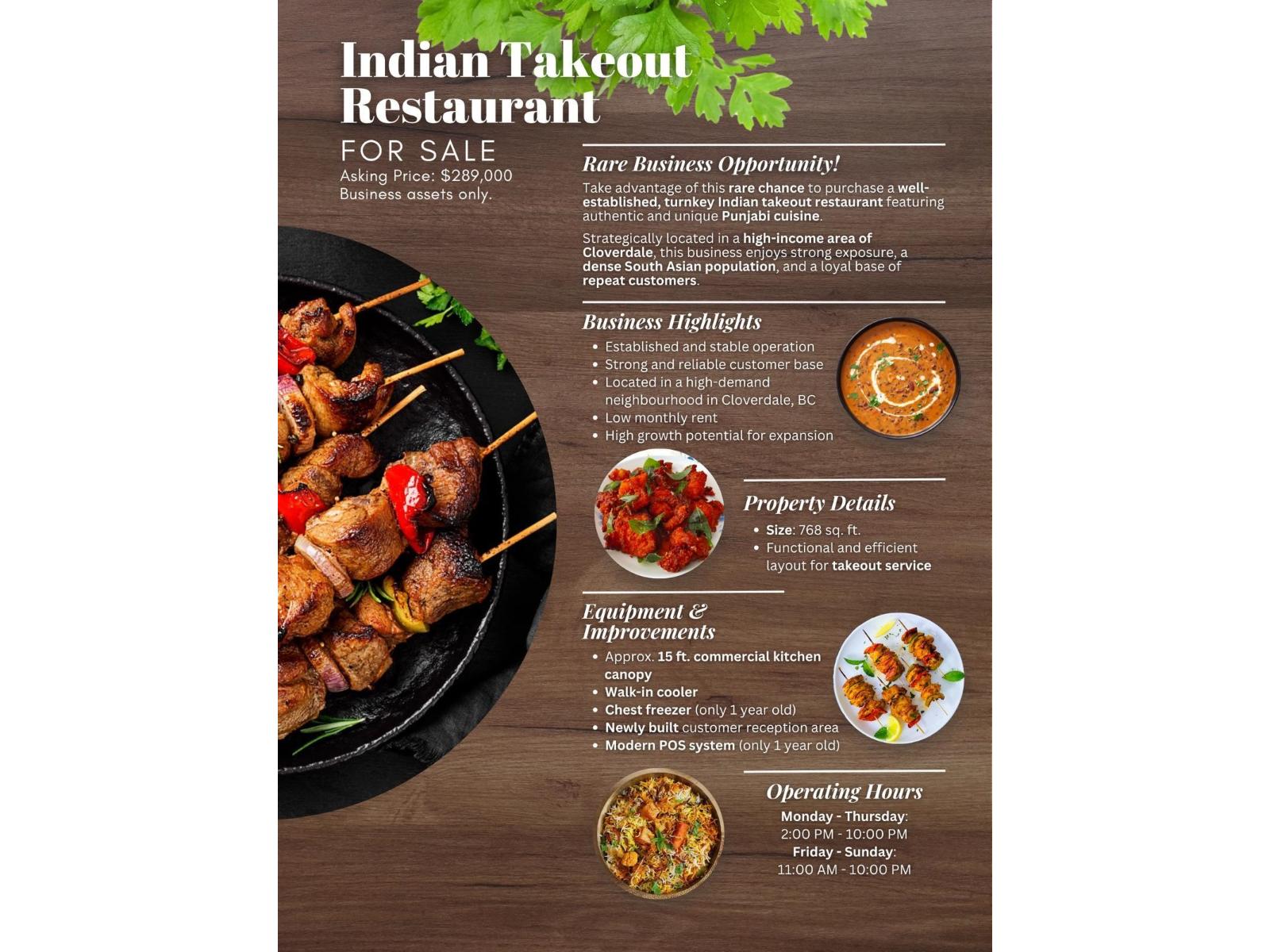
The average asking price for Indian Restaurants : $601,629
The most viewed Indian Restaurants listings on FBF are linked below:
Written by David Turner, M.A.
Many successful entrepreneurs are turning to Indian restaurants in Canada as lucrative business opportunities, driven by the country's growing multicultural population and increasing appreciation for diverse cuisines. With evolving customer preferences trending toward authentic ethnic dining experiences, you'll find a market ready to explore traditional Indian flavours.
Despite changing food regulations, the Indian restaurant sector continues to show strong growth potential. The foodservice industry in Canada is a significant economic contributor, serving millions daily, and Indian restaurants are well-positioned within this dynamic sector. The established infrastructure and systems in an existing Indian restaurant can notably reduce your startup time and costs while providing immediate cash flow potential through an existing customer base.
Weighing the advantages and disadvantages of purchasing an existing Indian restaurant can help you make an informed business decision that aligns with your entrepreneurial goals. When evaluating opportunities, you'll need to ponder factors like seasonal profit margins and rent negotiation flexibility, which can substantially impact your success.
|
Aspect |
Advantages |
Disadvantages |
|
Operations |
Established systems |
Inherited processes |
|
Equipment |
Ready infrastructure |
Potential repairs |
|
Location |
Proven customer base |
Fixed lease terms |
|
Financials |
Known performance |
Seasonal fluctuations |
Your decision should account for these key elements while reflecting on how they align with your vision for growth and operational style in the Canadian market. Consider also exploring financing options available for growth and business purchases, as they can provide the necessary capital to ensure a smooth transition and tackle any initial challenges you may encounter.
Purchasing an Indian restaurant involves several critical steps that require careful consideration and strategic planning to guarantee a successful acquisition.
Read more
When evaluating potential restaurants, consider both restaurant concept considerations and target customer demographics to ascertain alignment with your vision and market potential.
Understanding these criteria will narrow your focus to properties that match your investment goals and operational capabilities while helping you avoid opportunities that don't align with your strategic objectives. Additionally, exploring regional economic development resources can offer useful information about the local market dynamics and opportunities specific to your chosen area.
You'll want to partner with experienced professionals who possess relevant business broker credentials and accountant credentials specific to restaurant acquisitions. Your team should include professionals who understand the unique aspects of the Canadian restaurant industry. Consider engaging a professional from Venture Connect, as they have a variety of restaurant businesses for sale in British Columbia.
| Professional | Key Role | Essential Qualifications |
| Business Broker | Transaction Facilitation | Restaurant Industry Experience |
| Accountant | Financial Due Diligence | CPA, Restaurant Expertise |
| Lawyer | Legal Protection | Restaurant Transaction History |
Select team members who'll champion your interests while moving through complex regulations, financial analysis, and legal requirements throughout the acquisition process.
Research your competitors' menus, pricing, service models, and unique selling propositions to identify market gaps. Your competitive positioning should consider factors like authenticity, regional specialties, and price points that'll set you apart.
You'll want to evaluate competitors' customer reviews, peak operating hours, and delivery services. This data will help you determine how to differentiate your restaurant and capture market share effectively
After identifying potential targets, schedule a seller interview to understand their motivations, operational history, and financial performance.
Before making an offer on an Indian restaurant, you'll need to thoroughly examine the historical financial statements, review premises lease agreements, and analyze a detailed asset list including kitchen equipment, fixtures, and furnishings.
You should also calculate all anticipated acquisition costs, including closing fees, permits, training expenses, and potential renovation needs that may arise post-purchase.
Reviewing historical financial statements represents the cornerstone of your due diligence process when evaluating an Indian restaurant for purchase. When you review historical financial data, you'll want to assess profitability metrics against industry benchmarks to ascertain the business is financially sound.
| Operating Metrics | Target Range |
| Cost of Goods | 29% - 32% |
| Labor Costs | 30% - 32% |
| Operating Costs | 18% - 20% |
| Rent | 6% - 8% |
| Cash Flow | 10% - 12% |
You'll want to verify that the operation maintains food costs between 29–32% and beverage costs between 22–32%, depending on the specific category. Additionally, it is important to consider the high turnover rates in the food service industry, which can affect staffing stability and overall operating costs.
A detailed lease and title review stands as one of the most critical steps in your pre-offer due diligence process for an Indian restaurant acquisition. You'll need to carefully examine the lease expiration dates, renewal options, and any restrictions on business operations or property modifications.
Pay particular attention to clauses regarding property damage, maintenance responsibilities, and permitted uses. If the restaurant owns its premises, conduct a thorough title search to uncover any liens, easements, or zoning restrictions that could impact your operations. This review helps you understand your long-term occupancy rights and financial obligations.
You'll need to carefully evaluate the equipment inventory, facility maintenance records, and all tangible assets that contribute to daily operations.
| Asset Category | Items to Review | Documentation Needed |
| Kitchen Equipment | Ovens, Tandoors, Refrigeration | Maintenance Records |
| Dining Room | Tables, Chairs, POS Systems | Asset Lists |
| Food Service Items | Plates, Utensils, Linens | Inventory Counts |
| Small Equipment | Mixers, Food Processors | Purchase Records |
| Specialty Items | Traditional Cookware, Decor | Valuation Reports |
This detailed review guarantees you're making an informed investment decision while identifying potential maintenance issues or replacement needs.
Beyond the purchase price, you'll need a comprehensive startup budget that accounts for working capital requirements, change costs, and potential improvements.
Factor in these expenses when determining your total investment to guarantee you're adequately capitalized for a seamless ownership shift and successful launch under your management.
A qualified business broker will analyze the restaurant's income statement, market positioning strategy, and operational metrics to determine its worth using three key methods: income-based (EBITDA/SDE multiples), asset-based, and market comparables.
They'll typically apply multiples of 3-4x EBITDA or 2-3x SDE for transactions under $650,000, while considering factors like location, goodwill, and recent comparable sales in the Indian restaurant sector.
When you're ready to make an offer on an Indian restaurant for sale, you'll need to decide between structuring it as an asset sale or share purchase while considering whether to request partial seller financing to optimize your initial capital outlay.
Your offer should include provisions for a comprehensive seller training and handover agreement, which will help ensure a smooth changeover of operations, relationships with key vendors and staff, and transfer of vital operational knowledge specific to Indian cuisine and restaurant management.
Before moving forward with purchasing an Indian restaurant, you'll need to determine whether to structure the transaction as an asset sale or share sale, as this decision greatly impacts both tax implications and liability considerations.
| Consideration | Asset Sale | Share Sale |
| Tax Impact | Step-up in asset basis | Carry-over tax attributes |
| Liabilities | Limited to acquired assets | Assume all liabilities |
| Complexity | Less complex | More complex |
| Cost | Generally lower | Generally higher |
An asset sale typically offers more protection since you'll only assume specific assets and liabilities you choose, while a share sale means taking on all company obligations, known and unknown.
Requesting partial seller financing represents an essential strategic element when preparing your conditional offer to purchase a restaurant, as it can greatly reduce your initial capital requirements while demonstrating the seller's confidence in the business's future success.
When you request seller credit terms, aim to negotiate a purchase price that includes 15-20% seller financing over 2-5 years. This arrangement not only eases your cash flow but also guarantees the seller maintains a vested interest in your success. Structure the financing terms carefully, considering interest rates, payment schedules, and potential early payoff options.
Before proceeding, you'll want to create a detailed checklist covering all major kitchen equipment, dining room furnishings, and operational systems.
Carefully examine the condition of high-value items like refrigeration units, cooking ranges, ventilation systems, and POS terminals. Document any repairs needed or equipment that requires replacement. This assessment will help you negotiate fair terms and avoid unexpected expenses after taking ownership while ensuring you're acquiring assets that align with your operational needs.
You'll need to carefully review compliance documentation and verify that all requirements meet current municipal business licensing standards.
Request access to the restaurant's complete health inspection checklist from the past two years to identify any recurring issues or violations.
Working with your broker, guarantee all permits are transferable and maintain clear documentation of your findings for reference during purchase negotiations.
Crafting a detailed seller training and transition agreement marks a pivotal milestone in your restaurant acquisition process, as it establishes clear expectations and responsibilities for both parties during the handover period.
Your agreement should outline specific migration planning elements, including the duration of seller training, key operational procedures to be covered, and knowledge transfer requirements for signature recipes and cooking techniques.
Additionally, guarantee the document addresses staff retention strategies, vendor relationship handovers, and customer base preservation methods.
Include provisions for post-sale consultation availability and specify any compensation arrangements for the seller's continued involvement during the changeover period.
The detailed business plan for your Indian restaurant acquisition serves as the cornerstone document that'll determine your financing success and guide your ownership changeover.
When creating a detailed growth trajectory, incorporate the existing restaurant's performance metrics while reviewing financial forecasting assumptions against industry benchmarks for Indian cuisine establishments.
Consider incorporating authentic Indian recipes, specialized equipment needs, and staffing requirements specific to Indian cuisine into your financial projections, ensuring your business plan reflects both market realities and growth potential.
You'll need to coordinate with your broker to guarantee the proper execution of all closing documents, including the deal structure, purchase agreement, and transfer of permits.
During this phase, you'll also need to address post-closing obligations such as POS system changeover, staff training, and vendor relationship shifts.
Key industry information sources include:
Provincial Restaurant and Food Association Publications.
Local Chamber of Commerce Market Research Data.
Understanding government licensing requirements and preparing for health code inspections are essential steps in your acquisition process.
| Regulatory Level | Key Requirements |
| Federal | Food Safety Certification |
| Provincial | Business Registration |
| Municipal | Zoning Permits |
| Health Department | Kitchen Inspections |
Your compliance journey will involve obtaining necessary permits, maintaining proper food handling certifications, and ensuring the establishment meets current health and safety standards.
To maximize your success as a restaurant owner in Canada, you'll find numerous professional organizations and support networks ready to assist with your business journey
Key organizations offering support include:
Access these resources to strengthen your business foundation, stay compliant with regulations, and implement proven growth strategies in the competitive Canadian restaurant market.
While you might feel hesitant about entering the restaurant industry due to its specialized nature, you'll find that with proper due diligence and professional guidance, acquiring an established Indian restaurant in Canada can be a rewarding investment.
By carefully evaluating the financials, understanding market trends, and following regulatory requirements, you're positioning yourself to capitalize on Canada's growing demand for authentic Indian cuisine in a structured, profitable way
A: You'll find around 65% of Indian restaurants shift successfully when keeping existing customer retention rates. Your success odds increase by 15% if you maintain staff through profit-sharing models during ownership changes.
A: It will take your staff 2-3 months to master authentic Indian cuisine. Even experienced cooks face cuisine adaptation challenges when learning complex spice combinations and traditional cooking techniques.
A: You'll want to research Tandoori Express and Bombay Bhel, as they've shown strong franchise success. Consider their ownership requirements and established supply chains when evaluating your options for maximum independence.
A: A prime location in Ontario for an Indian restaurant would typically be in a high-traffic area with excellent visibility and ample parking. Being located near other popular spots can also help attract a loyal customer base.
A: Yes, there are Indian takeout options available for sale in Vancouver. These businesses often thrive due to the city's diverse food scene and the popularity of Indian food.
A: When looking for a well-established Indian restaurant for sale, consider factors like a loyal customer base, low rent, a well-maintained space, and a favourable reputation in the community.
A: Yes, South Surrey offers fantastic opportunities to acquire profitable Indian restaurants. These businesses often benefit from the area's growing population and demand for diverse food options.
A: Absolutely! Edmonton has several franchise restaurants for sale, including Indian cuisine options. These can be a fantastic turnkey opportunity for those looking to enter the restaurant industry.
A: Yes, Ontario has several dine-in Indian restaurants available for sale. You can find these well-established businesses by searching on platforms like FindBusinessesForSale.com.
A: Buying an Indian restaurant located in the heart of Vancouver offers benefits like high foot traffic, a diverse customer base, and the chance to thrive in a vibrant dining scene.
A: When buying a franchise for sale in the Indian food sector, consider the franchisor's reputation, support system, and the restaurant's current performance. It's also essential to evaluate the location's potential for growth.
Data is supplied by CREA who is the owner of the copyright in its MLS®System. Data provided is deemed reliable but is not guaranteed accurate by CREA. The trademarks MLS®, Multiple Listing Service® and the associated logos are owned by The Canadian Real Estate Association (CREA) and identify the quality of services provided by real estate professionals who are members of CREA. Used under license.